

The Face Behind: Interview with Skizologic
Updated: Jul 4
Maor Hasbani - better known as Skizologic - is one of those artists you don’t just hear, you experience.
From the outside, it might look like a journey built on big festival stages, powerful releases, and a sound that carved its own lane in the global psytrance scene.
But behind it, there’s a much deeper story - one of dunes and basements, of handmade parties and relentless curiosity, of a person who simply can’t stop chasing the feeling music gives him.
In this conversation, Maor opens up about the early days in Rishon LeZion, the wild evolution of the Israeli trance scene, the balance between artistry and precision, and the mindset that keeps him pushing forward - both as a creator and as a driving force behind others.
What stood out to me the most is the duality: a get-things-done kind of person, who steps into the studio and becomes almost surgical - shaping sound with intention, while still chasing that same raw spark that started it all.
I first met Maor in person at a wedding I was playing (the afterparty part).
A few tracks into my set, the groom came over and said, “Maor is here, can he play?” "Maor - Skizo?" I said, " Sure thing!"
Within minutes, he plugged in his USB and completely took over the dance floor, turning the night into a full-on explosion of energy.
Over the years, our paths crossed again at the FM Booking office, and it was clear to me that there is an easy, natural connection between us, and it's just a matter of time until I interview him.
When I invited Maor to play at one of my parties, that time had come, and I'm honored and proud to share his story with you.
Here it is: The Face Behind the Artist — Skizologic.

Interview with Maor Hasbani, Skizologic
Where did you grow up, Maor?
I grew up in Rishon LeZion and lived there until I spent about a year and a half, on and off, in India at the age of 21. Then I moved to Tel Aviv around 2010.
I lived in Tel Aviv for 11 years. Then I flew to spend some time in Australia, came back to Rishon, and today I live in a cooperative agricultural community or village (moshav) in central Israel.
A lovely house, I must say.
I'd like to hear about your childhood. What kind of guy were you in the hood? We were street kids. Growing up in the dunes and open fields, back when nothing was really built there yet. I was always hanging out with older guys.
What did you use to listen to?
I used to sit and wait for Fridays just to go to “Krembo” - a record shop in Shenkin Street, where the trance community people who shared the same passion for music would meet and buy records in the heart of Tel Aviv. The shop ran by Zoo-b, and there was a bar where you could sit with a Discman and headphones, and he would bring you CDs to listen to.
I would just listen to whatever he gave me, and slowly I started discovering music by Hux Flux, X-Dream, Raja Ram stash bag, Psysex, GMS…
What first pulled you into electronic music, and trance in particular?
At 13, I was already asking for trance to be played at my Bar Mitzvah.
I had a basement at my parents’ house, and I would just sit there for hours listening to trance music.
I don’t know exactly how trance caught me, but it could be related to my older friends I used to go around with.
When you heard it, back then, did you know that it would become such a big part of your life?
I’m a very practical person. If I want something, I go for it - and if it works, I keep going.
At first, it was just about going to parties and having fun.
How did you evolve to be a DJ?
I was collecting a lot of music, and one of my brother's old friends heard about my passion for DJing and lent me an old Denon player that worked with CDs. I needed a mixer, and at that exact time, Zoo-B was selling his gear, so I got a Gemini mixer from him.
I would sit at home and play for myself with Pioneer headphones that my mom bought me.
At the same time, I also started promoting parties for him.
I couldn’t really mix at first, until one day I read online about beatmatching. I took two tracks at 145 BPM, tried it, and suddenly it clicked. That’s when I understood what was going on.
Around that time, I was also hanging out with Ofer, who also played trance, and he introduced me to a lot of online forums - that’s how I discovered Isratrance by Shahr Bar-Itzhak (today Astrix's partner in Shmanic Tales) and really started understanding the scene.
From there, I realized - if I want to play, why not throw my own parties? My dad had a sewing workshop; he designed dresses, and my mom worked with him. I asked them to make me a shade tent for a party. I would ask people if they wanted to come, write their names and phone numbers on paper, and send SMS messages: “There’s a party.”
The first one was near Latrun, at Kibbutz Neve Shalom in 2004. About 80 people showed up. All I cared about was playing and having people hear me.
How have the parties evolved?
At one of the parties, I met my longtime partner, Tal Pinto. He was already doing parties in Kibutz Na’an, and I suggested we join forces and do something bigger.
We called it Adrenochrome - inspired by Fear and Loathing in Las Vegas.

Over time, we evolved - from rough kids into something more like a colorful, alternative-hippie crowd.
At the peak of our journey, we were playing Goa trance often, and then we decided to gather forces with Psilosiva prod to drop a massive Goa lineup like the old days (with headliners like Ubar Tmar, Tsuyoshi Suzuki, Tim Schuldt, and Etnica).
Around 2,000 people showed up, and of course, the police shut it down at 9:00 AM.
Then we did another one with Eat Static and Sandman. Same story: thousands of people, cars surrounding the area, and again, the police shut it down. This time, they even arrested Pinto and me.
That’s when we understood that if we want to keep doing this, we need to scale properly.
So we created Solaris, a legal event, and organized it properly. Around 5,000 people would show up.
All this at what age?
It was in 2011, when I was 24 and lived in Tel Aviv.
Crazy man!
How did Tel Aviv change things for you?
So... That’s where things took a different turn.
One day, Roy Fritzi Friedman, a key character in Tel Aviv's night scene who ran clubs like Breakfast and Beit Maariv where global artists played every weekend, called Pinto and told him that the Yarkon police station had moved location, and suggested to take over the space, open a trance line, and calling it “Klika Merhav Yarkon” - like the police station name. That’s how the Klika was born. It was a different kind of line; we wanted to bring the energy of nature into the city. And somehow, it worked. The crowd from the outdoor scene started showing up, even though the line was on Mondays.
We were all single, living near the sea… the apartment was always full of people, friends from abroad, random connections, beautiful souls coming and going. Within all the hustle and bustle around, I was sitting in the living room - playing with my gear, inviting random people: "Hey, listen to this, listen to that..."
Anyway... Fritzi would bring in new faces, and suddenly it became a whole thing.
But it wasn’t just about the music - we brought unique content. One night, we had performers from the musical Hair with acrobats in the middle of the dance floor. Another night - a mustache competition with prizes.
Then we moved to Breakfast, and later to the Junkyard, which had this amazing courtyard and an indoor club. There, we started bringing more unique acts, such as Eat Static, Ott, and others.
At our peak, we had around 2,000 people in Tel Aviv on a Monday night! At 900, we would already stop entry.
Eventually, we moved to the Clara.
And from there… we also naturally found our way back to nature and made trance parties outdoors.
Wow Maor... It sounds like such a beautiful time.
I'm wondering how you started producing your own music? At 16–17, a friend installed "Reason" (music production software) for me, and I started playing around in my basement. I had a few tracks, but didn’t really do anything with them, and it just stopped because of life...
Around 2012, something came back. I was DJing a lot and felt like I wanted to take it further.
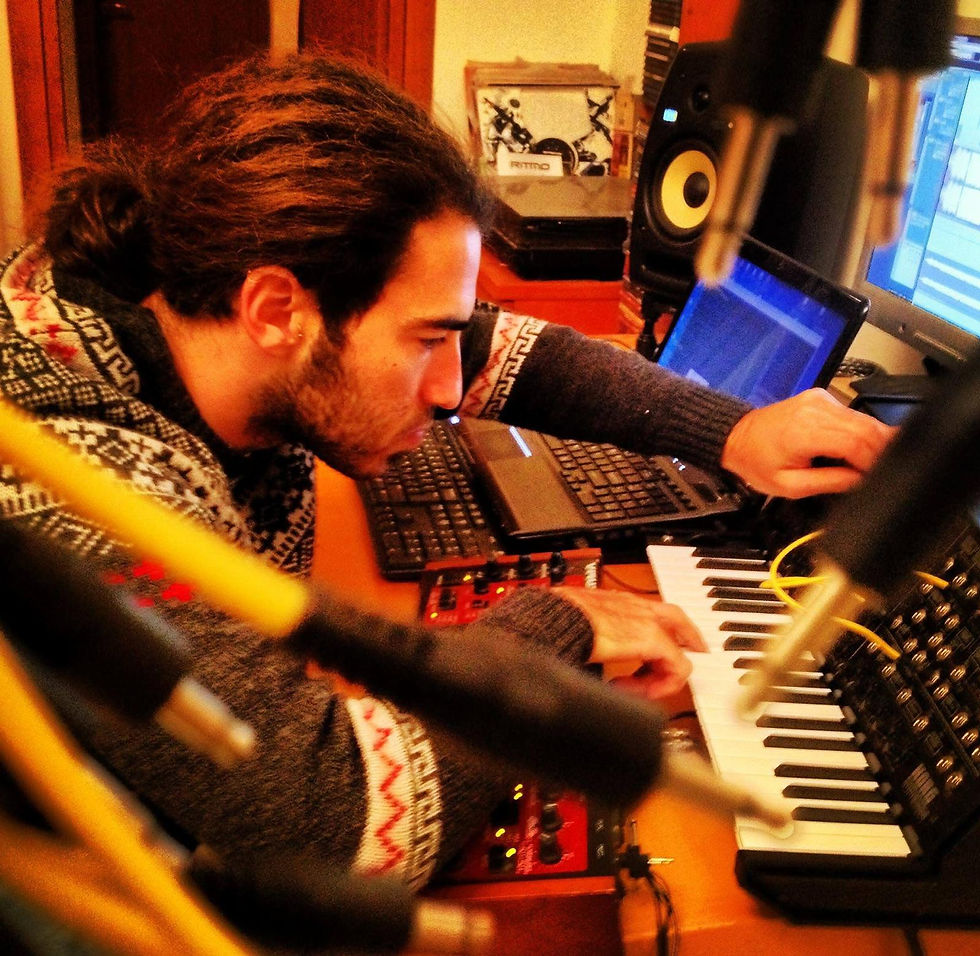
Friends brought me a keyboard and monitors, and I got back into it, and from that moment, I didn’t stop.
I would sit 8–10 hours a day, digging deep.
Artists were constantly at my place, sleeping on the couch, making music. Psysex, Shidapu - I learned a lot just by watching them.
At one Klika beach event, Shidapu was playing and had just launched his label Zion 604. I loved the direction, young Goa artists, and I sent him my music. He actually released my first track.
Which artists shaped your musical identity the most?
Simon Posford - from then until today.
Also, a lot of Japanese and Australian artists that broke my direction open - Prana, Tsuyoshi, Ubar Tmar, Nick Taylor, Ray Castle.
Also, Man With No Name, Union Jack, and Art of Trance influenced me.
Can we hear them in your music today?
Of course!
It sounds like you are working around music forever... Have you ever had another job?
Luckily, not really. I’ve always worked within the scene in one way or another.
I was close with Eliran Slider, the owner of FM Booking, and around 2015, I started managing his bookings in Israel. Then, in 2018, I told him I wanted to grow myself musically and that it was time to focus on my own project, so I took a break from the job at the agency and pushed it.
I released my album… and then after COVID, when Eliran asked me to take the international side, I came back.
And from there, things started expanding.
Would you attribute this to your job and connections?
I'm glad you asked about it. I never used connections to get on stages, but of course, knowing and working with promoters didn't hurt.
Luckily, everything comes from the music.
I did use my own parties to play my music - that helped.
Today, through my booking work, I promote a lot of top Israeli artists - and I will always push them before pushing myself.
I discovered Skizologic on your first Boom. Honestly, I was surprised to see an Israeli artist I didn't know too much about, and I loved your performance there.
How did you pave your way to Boom?
I fulfilled the application for a few editions. I sent my music and physical copies of my previous albums to the program team, and luckily, it caught someone's ear, and I was invited to play.
Wow - how did it feel?
It was my main goal and among my biggest dreams; I couldn't believe it until it happened.
It was a dream come true.

What made you start a new project like GUMI?
We were always very eclectic - downtempo, glitch, alternative stages, live acts, psychedelic rock.
So creating something like Gumi felt very natural.
And now you also have Square... That's a lot to manage and to accomplish along with your daily job in FM Booking - how do you manage to do that?
Today, honestly, some projects do get affected musically because I’m so busy.
In the past, it was easier to finish tracks and release them.
Now I’m more loaded and also more precise, because the crowd wants to hear Skizologic, so when I release something, it has to be perfect.
So it takes longer.
But the simple answer is — I work very hard.
When you produce music, do you think about yourself or the crowd?
That's a good question... a tricky one.
I'd say both.
At the beginning, I just wanted to get everything out of my head. I had so many ideas that came from so many influences... I just wanted to finish and move on to the next idea.
That’s something I’d actually recommend to young artists — just create a lot. Don’t get stuck.
Today, and that's thanks to the audience, I have clearer language. I know what I want to deliver.
And now that there’s an audience waiting, I definitely build for them - but of course, I have to be connected to it and love it.
I also feel a mission not to “spoon-feed” - I want people to work a bit, to go through a journey.
How do you manage work-life balance in this?
I try to dedicate specific days to the studio and others to different projects.
I met my wife at Indigo 2013 - a legendary festival by the Sea of Galilee. She is my best friend, and she is helping me so much, giving me what I need to succeed.
That's nice, I know it is not easy at all.
Yes. The kids know that their father is abroad a lot, but they get some presents from all around the world, so they are happy about it.
How do you approach building a set for a festival?
I try to understand the vibe of the event, where I fit in the lineup, and who plays before and after me.
Usually, I try to capture everyone in the story first, and then I feel free to push further or play whatever I want.
I have certain sequences that I know work, and I use them when needed.
At the end of the day, I started as a DJ, so a lot of this comes from experience and spending years behind the decks.
Do you feel that your personal life experiences directly influence the sounds and emotions you create as Skizologic?
I’m a sensitive person by nature.
But in the studio, I become very technical, almost disconnected, so I can open a different emotional space through the music.
Sometimes life inspires things, but usually I create because something excites me - a sound, a tutorial, an idea.
I learned so much from my collabs.
Every artist brings a new perspective. Some are more technicians, some musicians... Each one expands my knowledge and approach.
Are you more of a Musician or Technician?
Music is flowing in me since ever. However, I never learned Music Theory so I would say I am very geeky in Synthesis.
How does a collab come to life?
It happens naturally - a vibe, meeting someone, someone comes to the studio, something clicks.
Let's take Psyko Disko - Nobody (Ace Ventura & Skizologic Remix).
I have a track with Libra called Message from the Deep with a section influenced by Australian trance that got Yoni's (Ace Ventura) attention and he told - "Hey it sounds Australian, I'm influenced by the guys there, like Psyko Disko". As we just found we both influenced by the same Australian artists, I took the vocal from "Nobody" by Psyko Disko and reverse engineered the original track notes and sent to Yoni. One thing led to another - and the track was born.
.
That's a great story, thanks for sharing this with me.
Tell me, what does Skizologic stand for?
It was my name as a DJ.
Back then, people used to call the music “sick” (means - Killer) so schizophrenia - Skizologic - just made sense to me. Today I might pick another name :)
What's your approach to branding?
I think it is a MUST.
I’ve worked with a few people over the years.
But creatively, everything I do is based on art and visuals. I love illustrations.
If something catches me, I go for it.
For example, with Gumi’s Underwater album, I worked with an English artist I found on Instagram who paints in water. He got me!

I just saw your new Skizologic website, and now I understand how it connects to your brand vision.
Big like
What's your next dream?
A new album - it’s already in the works ;)
How do you approach making an album?
So, I was actually looking for the track that would trigger me to make a whole album around it, and I just got it not long ago.
At this point, Maor starts going “listen to this” and plays me a few unreleased tracks.
Let’s just say — a very joyful album is on the way.
Is there a message you are trying to deliver to the audience?
I want you to feel like you need to catch your breath after the set - like you just went through a journey.
What do you think about the Israeli trance scene today?
I really enjoy the scene in Israel today.
Many communities are creating great events. There’s an abundance - every weekend, so many parties.
We even created a new sound for the world - that kick-bass energy.
Artists like Astrix, Psysex, Loud, Infected Mushroom - helped bring it out globally.
They brought innovation before, and I feel like it’s still happening today.
I'm proud of what the Israeli trance scene accomplishes.
OK Maor... that was marvelous, such an honor to speak with you this far.
After diving deep into the heart of Skizologic, let’s recap with a playful association game.
I ask, you fire an answer.
Ready to go?
Bring it on!
What track can you use that will always do the job?
It’s hard for me to say.
Every track has its own time and place. I don’t feel like there’s a single track of mine that works in every situation, even Hypersphere or Japanic Panic, which are considered big ones.
What's your favorite track?
There was a live set by Simon Posford, from a show in San Francisco, that I ran with for years - it opened with a live version of LSD, and that track completely changed the way I see trance.
Also - Union Jack, (by the way, I remixed Tempest with Shidapu, my teammate on The Square project).
And Octopus by Art of Trance - anyone should listen to that.
A DJ you would like to play with?
Not that I see how it clicks... but to name one artist, I'd say Simon Posford. And if I could pick another pls, I'd say Prana
Your peak DJ moment:
Boom 2018.
Most embarrassing DJ moment:
I once had the chance to play at Twisted Festival in northern Israel. About ten seconds after my intro, one of the CDJs just died. With no backup gear available, the entire stage went silent - and I was left standing there, completely helpless. At least, it happened on the smaller stage and not the main one...
If you were a famous star, who would you be?
Something between Tarantino and Jim Morisson
Message to the audience:
Believe in what you do, do it at your best, and never give up. Faith is the way.
Maor, wow… what an inspiring conversation. I learned so much about you - your passion, your perspective, and the journey that shaped you. The way you grew within the scene and your contribution to our trance culture are truly remarkable.
I’m grateful for the opportunity to share your story.
Thank you, Skizo - and I’m sure whatever you set your mind to next, you’ll make it happen.


Comments